Development followed an incremental milestone-based workflow.
Web Development · Portfolio · CM / 2026
Prisca.Dev
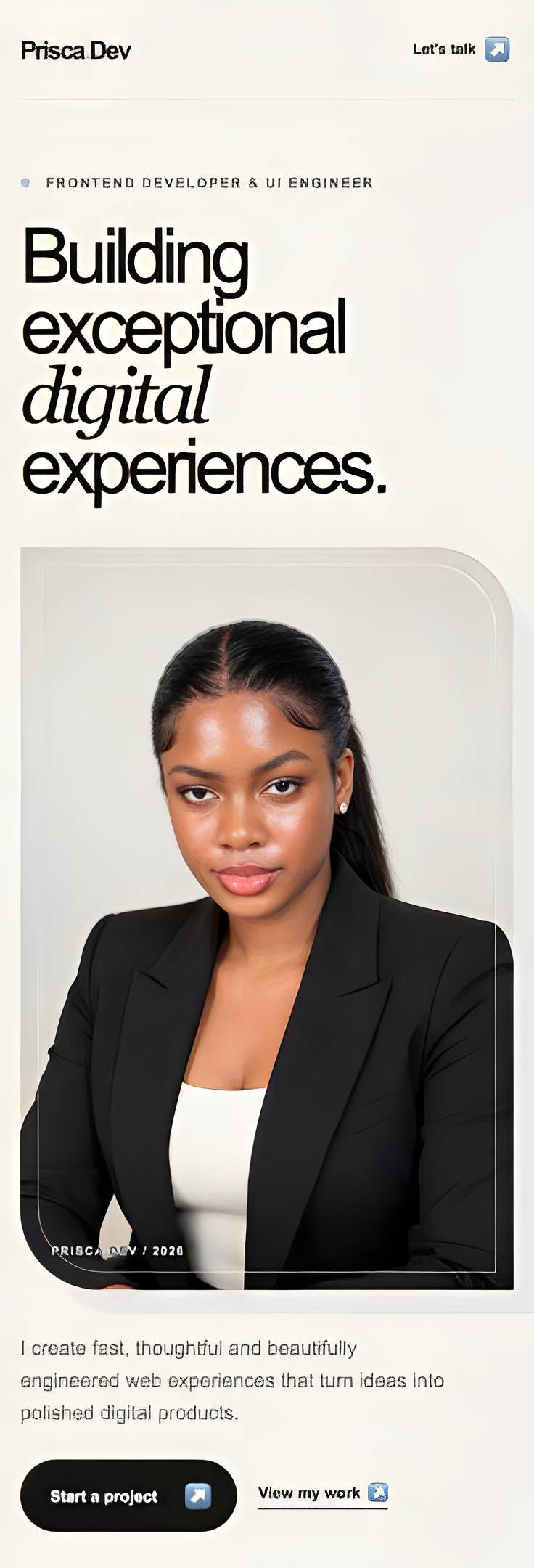
A premium developer portfolio and custom content management platform built to showcase projects, technical capabilities, professional experience and services through an editorial public website backed by a secure, fully editable administration system.
- Role
- Full-Stack Developer · Frontend Developer · UI Engineer · CMS Developer
- Year
- 2026
Overview
Prisca.Dev is a custom developer portfolio platform designed to provide both a polished public-facing professional presence and a practical content management system for maintaining portfolio content without editing source code. The platform combines a modern editorial interface with a protected administration environment for managing profile information, projects, case studies, services, skills, professional experience, testimonials, team members, site settings and media.
Process
The initial phase established the public portfolio architecture and approved editorial visual direction. Project case-study routes and reusable layouts were then developed.
Supabase was introduced for database persistence and secure authentication, followed by the core administration system for Profile, Site Settings and Portfolio management.
The CMS was progressively expanded with Team, Services, Skills, Experience and Testimonials management. Reusable Supabase Storage upload functionality was then integrated for profile, project, team and testimonial media.
The public portfolio was progressively connected to CMS-managed content using safe fallbacks.
Each major milestone was built, manually tested, committed to Git and pushed to GitHub before the next phase began. The completed application was deployed to Vercel and production-tested against the live Supabase infrastructure.
Technologies
- React
- Tailwind CSS
- Supabase
- Next.js 16
- TypeScript
- HTML5
- CSS
- Next.js App Router
- Next/Image
- Next.js Server Components
- Next.js Server Actions
- PostgreSQL
- Supabase Auth
- Supabase Storage
- Row Level Security
- Structured relational content modeling
Key features
- Responsive developer portfolio
- Modern editorial UI
- Professional hero section
- Technology stack presentation
- Featured project showcase
- Detailed project case studies
- Services presentation
- Professional experience timeline
- Contact section
- Responsive desktop and mobile layouts
- Protected admin dashboard
- Secure admin authentication
- Profile CMS
- Portfolio and Projects CMS
- Rich project editor
- Project publishing controls
- Featured-project controls
- Project display ordering
- Services CMS
- Skills CMS
- Experience CMS
- Testimonials CMS
- Team CMS
- Site Settings CMS
- Project technical-detail management
- Project case-study management
- Supabase PostgreSQL integration
- Supabase Authentication
- Supabase Row Level Security
- Supabase Storage integration
- Profile portrait uploads
- Project cover image uploads
- Project thumbnail uploads
- Project hero image uploads
- Team-member image uploads
- Testimonial avatar uploads
- Image preview and replacement
- Public CMS data integration
- Safe CMS fallback content
- SEO metadata management
- Responsive accessibility improvements
- Reduced-motion support
- Production deployment through Vercel
My work
Work summary
Designed and developed the complete Prisca.Dev platform, including the public portfolio experience, responsive interface system, secure administration dashboard, portfolio/project CMS, structured project case studies, media-upload workflows, Supabase database integration, authentication, storage configuration and production deployment.
Contribution
Led the project from initial architecture and visual direction through implementation, CMS development, backend integration, production testing and deployment. I created the public interface, structured the content architecture, implemented the administration system, configured Supabase authentication and data access, developed reusable media-upload functionality and established the production workflow through GitHub and Vercel.
Build
Frontend
Developed the public portfolio using Next.js, React and TypeScript with a responsive editorial interface. Built the hero, technology strip, featured projects, services, about, statistics, experience, contact and footer sections while maintaining a consistent visual system across desktop, tablet and mobile devices.
Backend
Developed the backend content architecture around Supabase and PostgreSQL. Implemented secure server-side CMS operations, authenticated administrative routes, structured CRUD workflows and controlled public data access.
Database
Designed and integrated a structured PostgreSQL content model for the portfolio. Separate tables provide maintainable storage for administrators, profile content, projects, project sections, project media, services, skills, professional experience, testimonials, social links, site settings and team members.
UI / UX
Created a modern minimal/editorial design system intended to communicate technical credibility while maintaining a distinctive personal brand. The visual direction uses warm ivory and cream surfaces, near-black typography, restrained lavender accents, large editorial imagery, generous whitespace and carefully controlled hierarchy. UX refinements included responsive typography, navigation spacing, accessible focus states, project-card affordances, technology presentation, service hierarchy, experience scanning, mobile touch targets and restrained interaction motion.
Technical details
Technical overview
Prisca.Dev uses a full-stack Next.js App Router architecture with React and TypeScript. The public portfolio and administration system live within the same application while remaining logically separated through routing, authentication and data-access controls. Supabase provides PostgreSQL persistence, authentication and object storage. Server-side data access is used for public CMS content where appropriate, with safe local fallback content to protect the public experience if CMS data is missing or temporarily unavailable. Vercel provides production hosting and deployment from the GitHub repository.
Architecture
The application is divided into public portfolio routes and protected administrative routes. The public layer provides the editorial portfolio and project case studies. The administration layer provides CRUD interfaces for structured content management. Reusable Supabase client/server helpers centralize backend communication. Authentication guards protect administrative routes, while Row Level Security provides database-level authorization. Media uploads use a reusable uploader connected to Supabase Storage. Portfolio content is structured so individual sections can evolve independently without requiring a redesign of the public interface.
Authentication
Implemented Supabase Authentication for the protected administration environment. Administrative routes validate authenticated users server-side and verify authorized administrator records before allowing access to CMS functionality. The system uses authenticated Supabase sessions and Row Level Security rather than exposing privileged service-role credentials to the browser.
Data flow
Administrators authenticate through Supabase Auth and access protected CMS routes. Content changes are validated and written to Supabase PostgreSQL through server-side application logic.
Performance
The application uses Next.js rendering capabilities and server-side data access to minimize unnecessary client-side requests. Responsive assets and reusable interface components support efficient rendering while CMS fallbacks protect the public interface from backend content failures.
Security
Administrative pages and CMS mutations are protected through server-side authentication and administrator validation. Supabase Row Level Security controls database access, while public visitors receive read access only to content intended for public presentation. Sensitive service-role credentials are not exposed to the client application. Environment configuration is separated from source control and production environment variables are managed through Vercel.
Responsive design
The public portfolio was reviewed across desktop, laptop, tablet and mobile breakpoints. Responsive improvements were applied to hero typography, portrait positioning, project cards, technology presentation, service layouts, statistics, experience rows, navigation, contact sections and touch targets.
Testing / QA
Testing covered public navigation, responsive layouts, admin authentication, CMS create/edit/delete operations, visibility controls, project publishing, profile updates, Supabase database persistence, project media uploads, profile portrait uploads, team-member creation and image uploads, production environment configuration and Vercel deployment. Production testing confirmed that CMS changes persist through Supabase and are available to the deployed Vercel application.
Infrastructure
Infrastructure
The production architecture combines GitHub for source control, Vercel for Next.js hosting and continuous deployment, and Supabase for database, authentication and object storage.
Hosting
HOSTING DETAILS: Vercel DATABASE HOSTING: Supabase PostgreSQL
Deployment
The main GitHub branch is connected to the Vercel production project. Production environment variables configure the Supabase connection, allowing the deployed application to use the same secure CMS infrastructure as the development environment. Production deployment, authentication, database updates and Storage uploads were verified on the live application.
Skills used
Skills
- Next.js
- React
- TypeScript
- Tailwind CSS
- Supabase
- PostgreSQL
- Supabase Auth
- Supabase Storage
- Row Level Security
- Frontend Development
- Full-Stack Development
- CMS Development
- Admin Dashboard Development
- UI Engineering
- UI/UX Implementation
- Responsive Web Design
- Database Design
- Authentication
- Authorization
- Server-Side Rendering
- Server Components
- Server Actions
- Media Management
- API Integration
- Content Architecture
- Git
- GitHub
- Vercel
- Production Deployment
- Responsive Testing
- Quality Assurance
- Accessibility
- SEO
- Performance Optimization
Challenges solved
Creating an editable portfolio without sacrificing a custom-designed public experience
Separating protected administrative functionality from public portfolio access
Designing detailed project case-study data structures
Implementing secure Supabase authentication
Implementing Row Level Security for CMS data
Building reusable CRUD administration workflows
Creating reusable image-upload functionality
Managing production media through Supabase Storage
Providing safe public fallbacks for missing CMS data
Maintaining responsive behavior across desktop
tablet and mobile
Preserving the approved design while introducing dynamic CMS content
Handling project publishing and featured states
Creating scalable technical project-detail fields
Maintaining stable Git checkpoints throughout development
Configuring production environment variables securely
Deploying and validating the complete application on Vercel
Results / Impact
Production-deployed professional developer portfolio
Custom secure administration CMS
Responsive editorial public interface
Structured portfolio and project management
Rich technical case-study system
Supabase-backed content management
Secure production authentication
Row Level Security implementation
Production media-upload system
Reusable CMS architecture
Editable profile and site settings
Editable services and skills
Editable professional experience
Editable testimonials
Editable team members
Production Vercel deployment
GitHub-based deployment workflow
Responsive desktop
tablet and mobile experience
Scalable foundation for future portfolio expansion
Outcome
Outcome summary
Prisca.Dev was successfully transformed from a conventional portfolio concept into a production-deployed professional platform with a secure custom CMS. The final system provides a polished public developer portfolio alongside an administration environment capable of managing profile information, portfolio projects, technical case studies, services, skills, professional experience, testimonials, team information, settings and media. The platform is deployed through Vercel and connected to Supabase for production authentication, database persistence and media storage, providing a maintainable foundation that can evolve as the client's professional portfolio grows.
Lessons learned
Building the portfolio as a content platform rather than a static website created a more maintainable long-term solution. Separating visual presentation from structured CMS content allows the public interface to evolve without requiring portfolio information to be hardcoded. Incremental development, frequent testing and Git checkpoints also reduced regression risk as authentication, storage, CMS functionality and production infrastructure were introduced.
Next project
Style Vogue
Web Development · E-commerce · Fashion